

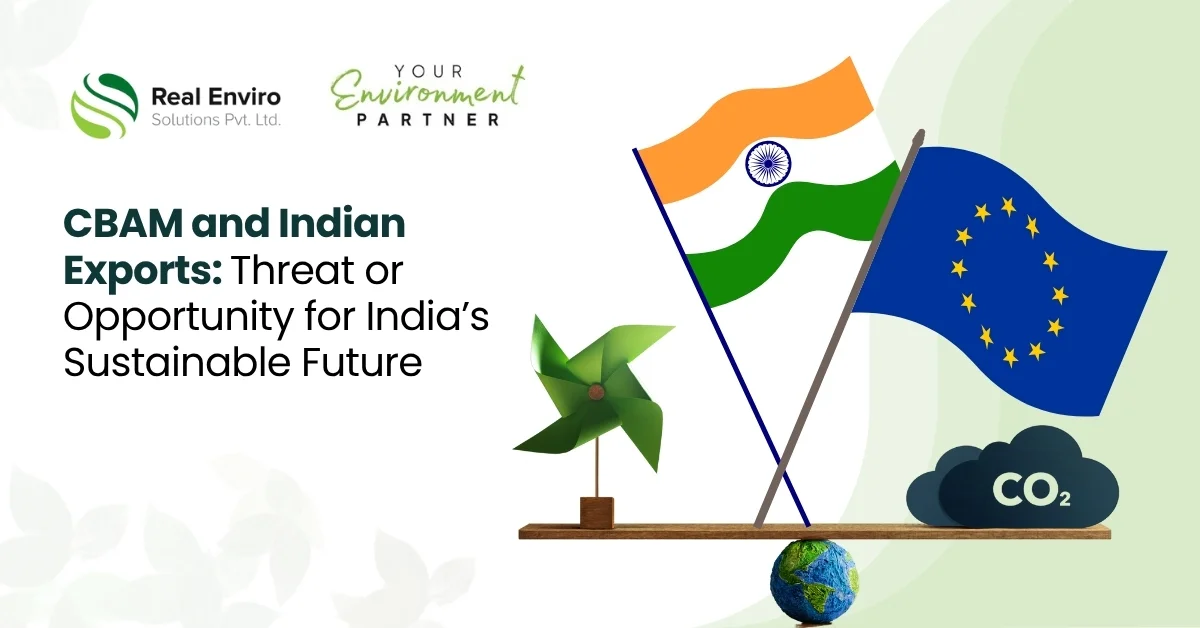
India’s exporters are entering a new climate era. With the European Union’s Carbon Border Adjustment Mechanism (CBAM) officially underway, the rules of international trade are being rewritten around carbon intensity and sustainability. CBAM is not just another environmental policy—it’s a transformative trade instrument that links carbon emissions directly to market access and pricing.
In simple terms, CBAM requires importers into the EU to pay a carbon price equivalent to what EU producers already pay under the bloc’s Emissions Trading System (ETS). Its goal is to prevent “carbon leakage”—that is, the shifting of emissions-intensive industries to countries with weaker climate rules. But for exporters from developing economies like India, the implications go far beyond compliance
The timing could not be more critical. The EU’s transitional phase of CBAM began in October 2023, with full implementation expected by 2026. As the world’s second-largest exporter of steel and a major supplier of aluminum, cement, and chemicals to the EU, India is directly in CBAM’s path. At the same time, global investors, buyers, and consumers are demanding stronger ESG (Environmental, Social and Governance) performance and verifiable decarbonization commitments.
What is CBAM?
The Carbon Border Adjustment Mechanism (CBAM) is the EU’s flagship climate policy designed to align trade with its carbon-neutral ambitions. It ensures that products imported into the EU bear a cost for their embedded carbon emissions—similar to domestic producers under the EU’s Emissions Trading System (ETS).
Under CBAM, importers must report the greenhouse gas (GHG) emissions embedded in goods such as iron and steel, aluminum, cement, fertilizers, electricity, and hydrogen. During the current transitional phase (2023–2025), companies must only report emissions; from January 2026, they will need to purchase CBAM certificates corresponding to the EU carbon price.
The underlying goal is to create a level playing field. EU manufacturers pay for their carbon emissions; CBAM ensures foreign producers exporting into the EU do too. This reduces the incentive for companies to relocate production to regions with weaker environmental rules—a phenomenon known as “carbon leakage.”
Why India Cannot Ignore CBAM
CBAM is not a distant European regulation—it’s a direct economic and reputational challenge for India. The country’s export exposure is significant. In 2022–23, India exported around €8–9 billion worth of goods to the EU from sectors covered under CBAM. Indian steel and aluminum manufacturers, in particular, are on the front lines.
The regulatory and financial risks are serious. Non-compliance could mean higher costs due to CBAM certificates or even loss of market access if importers prefer suppliers with transparent, verifiable emissions data. Beyond cost, there’s a reputational dimension—global buyers and investors are increasingly screening suppliers based on sustainability metrics.
Challenges for Indian Exporters
Despite the opportunities, CBAM poses several immediate challenges for Indian exporters.
1. Rising Cost Burden:
CBAM compliance will require exporters to measure, verify, and report embedded emissions accurately. This involves audits, certification, and possible investments in cleaner technologies—all adding to operational costs.
2. Data & Measurement Gaps:
Many Indian manufacturers, especially mid-sized firms, lack robust GHG accounting systems. Establishing accurate emissions baselines across supply chains will be complex and resource-intensive.
3. Capital Investment Needs:
Transitioning to low-carbon production demands heavy investment in renewable energy, electrification, and efficient manufacturing processes. Access to affordable green finance remains a barrier.
4. Competitive Pressure:
If competitors in other emerging economies (like Vietnam or Turkey) decarbonize faster or benefit from government incentives, Indian exporters could lose price advantage and market share.
5. Policy & Infrastructure Limitations:
India currently lacks a national carbon pricing framework or sector-specific emission factor databases, both of which are critical for CBAM compliance.
Role of Stakeholders & Ecosystem
Government
The Indian government must develop enabling policies such as a national carbon registry, emission factor databases, and export incentives for decarbonization.
Industry Bodies
Associations like CII and FICCI can play a crucial role in standardizing emissions reporting, conducting training programs, and sharing sectoral best practices.
Financial Institutions
Banks and investors should expand green finance offerings, providing loans and incentives for low-carbon technology adoption.
Consultants & Service Providers
Specialists can assist in auditing, certification, and strategic planning, bridging the technical gap between policy and practice.
Buyers & Importers
EU buyers hold leverage in shaping supplier behavior. Collaborative partnerships can help Indian exporters transition smoothly.
Collaboration
Ultimately, success will depend on public-private collaboration, innovation, and capacity building across the export ecosystem.
Conclusion
CBAM is more than a new regulation — it represents a structural shift in global trade, linking climate performance directly to market access. For Indian exporters, the risks are clear, but so are the opportunities for those who act early and strategically.
If you’re exporting to the EU (or planning to), treating CBAM as a mere compliance cost is short-sighted. Instead, view it as a strategic inflection point — a chance to leap-frog into the global low-carbon economy.
Start your carbon audit today, engage with decarbonization experts, and future-proof your business for the climate-conscious market ahead.